Certified Arabic Calligraphy
Adjudication Program (CACAP)
An institutional professional program delivered by the University of Arabic Calligraphy (UAC) to qualify adjudicators and standardize evaluation practice through verifiable criteria, controlled records, and evidence-based decisions.
Program Core
CACAP aims to convert adjudication from impression-based opinions into a standardized practice that can be explained, reviewed, and audited—by unifying how violations are defined, how deductions are applied, and how evidence is recorded.
Standardization
The program increases consistency across adjudicators using a unified rubric, so decisions are produced from defined items and linked evidence rather than personal taste or differing schools.
Digital Governance
CACAP uses a structured violation log and severity categories (Minor / Major / Critical) with defined deduction logic, making results reviewable and auditable.
Capacity Building
The program develops adjudicators who can justify decisions with precise technical language, while recording the reason, location, impact, and supporting evidence.
Structural Priority
Structural correctness is treated as a prerequisite: aesthetic judgment is not built on letterforms with incorrect proportion, baseline sitting, or internal form integrity.
Approved Evaluation Method
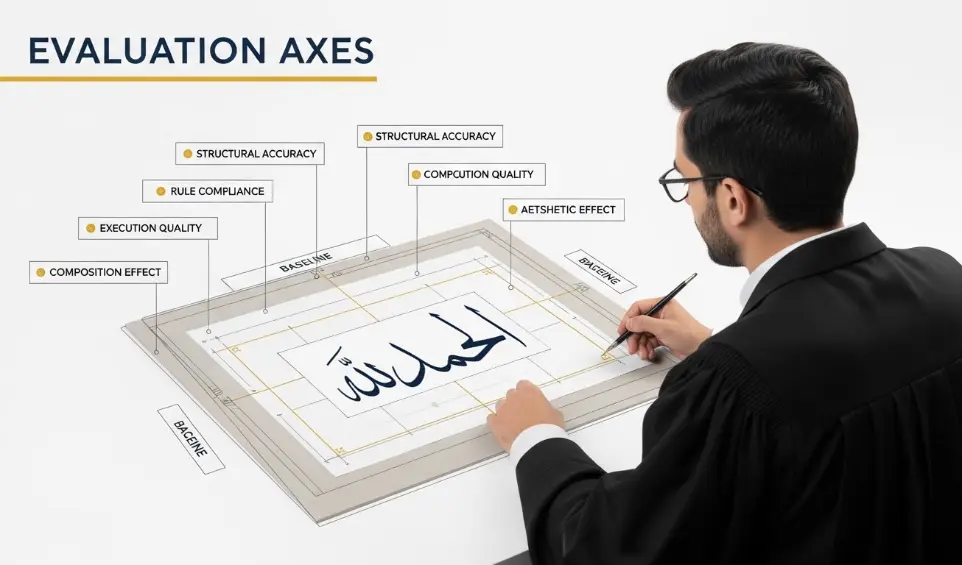
Evaluation Axes
The rubric uses core axes to pinpoint issues and record them precisely, ensuring every deduction is tied to a defined item.
Structural Accuracy:proportions, baseline sitting, internal relations, and reference alignment.
Rule Compliance: adherence to the established rules of the selected script and approved style.
Execution Quality:stroke control, pressure, stability, smoothness, and technical consistency.
Composition:mass/space distribution, spacing, rhythm, and overall balance.
Aesthetic Effect:overall harmony and visual readability without conflict.
Operational Rule (Short)
No deduction is approved without an official record in the violation log. Each entry must include: code, description, location, impact, and evidence.

1) Set Reference: Confirm script type and the approved reference style before evaluation.
2) Code the Issue: Select axis, item, and severity; then enter a concise description.
3) Link Evidence: Record location and impact, and attach/describe evidence before finalizing.
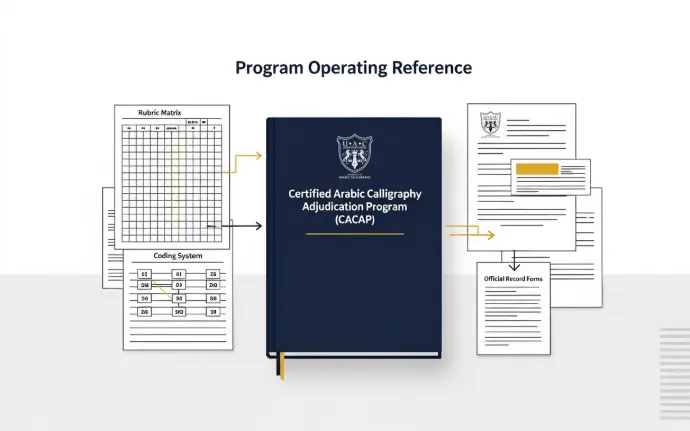
Program Operating Reference
The information on this page is derived from the “Certified Arabic Calligraphy Adjudication Program (CACAP) Book”, which serves as the official operating manual containing the rubric matrices, coding system, procedures, and approved records used by the University of Arabic Calligraphy (UAC).
Legal Notice
CACAP and all related materials, templates, and records are protected intellectual property of the University of Arabic Calligraphy (UAC). Reproduction, republication, or distribution of any part of the materials is prohibited without written permission from the issuing body. The official website remains the primary source for verification of information and versions.